
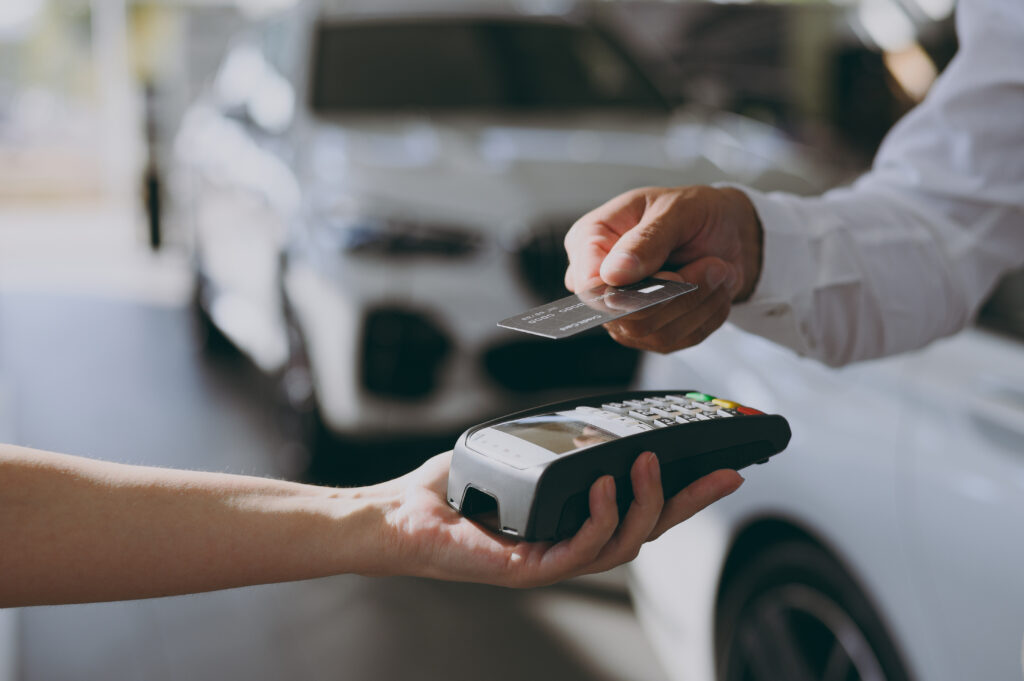
Most auto lenders don’t accept credit cards for monthly payments. That’s the short answer. The longer answer is that workarounds exist, each with its own fees and tradeoffs.
Why Most Lenders Won’t Accept Credit Cards
The reason comes down to processing fees. Credit card companies charge merchants between 1.5% and 3.5% per transaction. On a $400 monthly car payment, that’s $6 to $14 in fees the lender absorbs every single month. Auto lenders operate on fixed interest rate margins and have no appetite for that ongoing cost. So most simply don’t offer it.
Some lenders do accept cards but charge a convenience fee to offset costs. Before exploring any workaround, call your lender first and ask directly.
Why People Want to Pay Car Loans With a Credit Card
There are a few reasons people look for this option.
Rewards
A $400 monthly payment is $4,800 in annual spend. At 2% cash back, that’s $96 a year. A sign-up bonus requiring $3,000 in three months makes one or two car payments a quick path to earning it.
Cash Flow Timing
If your payment due date falls before your next paycheck, a credit card can bridge the gap for a week or two. This only works if you pay the card off in full when your paycheck arrives.
0% APR Opportunities
If you have a card with a 0% introductory rate and your auto loan carries meaningful interest, shifting some of the balance temporarily can save money during the promo period.
Workarounds and What They Cost
When lenders don’t accept cards directly, several workarounds exist. None is free, and some carry real risks.
Third-Party Bill Pay Services
Services like Plastiq let you pay almost any bill with a credit card. They charge around 2.9% per transaction and send the payment as a bank transfer or check.
Card network restrictions apply depending on your card type and lender, so verify compatibility before relying on this method.
Cash Advances
You can withdraw cash from your credit card and deposit it to your bank account to pay the loan. The problem is that cash advances typically carry a 3% to 5% fee plus an APR of 25% or more, and there is no grace period.
Interest starts accruing the day you take the advance. This is rarely a good option unless you can repay it within days.
Digital Wallets
Some lenders accept PayPal or similar platforms. Fees of up to 3.49% typically apply when funding from a credit card. These platforms also monitor for patterns that resemble fee arbitrage, so this is not a reliable long-term approach.
Balance Transfer Checks
Some card issuers send convenience checks that draw from your credit line. These can be made out to your lender. A one-time fee of 3% to 5% typically applies. If the card has a 0% promo rate and you have a concrete plan to pay it off before the rate expires, this can make financial sense.
Cost comparison at a $400 monthly payment:
| Method | Fee | Monthly cost ($400 payment) | Notes |
| Third-party bill pay (e.g., Plastiq) | ~2.9% | ~$11.60 | Card network restrictions apply—verify before use |
| Cash advance | 3–5% + 25%+ APR | $12–$20+ interest | No grace period. Interest starts immediately. |
| PayPal / digital wallet | Up to 3.49% | ~$13.96 | Unreliable long-term; platforms may restrict use |
| Balance transfer check | 3–5% one-time | $10–$16.67 amortized | Only useful with 0% promo APR and clear payoff plan |
| Direct (lender accepts card) | 0–3% convenience fee | $0–$12 | Rare. Call your lender to check. |
When It Actually Makes Sense
There are a few scenarios where using a credit card for a car payment might genuinely work.
Sign-Up Bonus
Let’s say you need $3,000 in spending to trigger a $500 bonus. Paying a 2.9% fee ($87) to earn $500 is a clear win, as long as you pay the card off before interest kicks in.
0% APR Promo
This can work if the processing fee is lower than the interest you’d pay on the auto loan during the same period, and you have a firm payoff plan.
Genuine Short-Term Cash Flow Gap
If you know the money is coming, and you will clear the card in full within days, not weeks, paying with a card might not be too damaging.
If You’re Struggling to Make the Payment
If the reason you’re looking at this option is because you’re having trouble making payments, a credit card workaround is probably not the best long-term solution. You may have better options.
Lender Hardship Programs
Some lenders offer deferment or forbearance options for borrowers experiencing financial difficulty. A single missed payment on a deferred loan is better than a cycle of credit card debt at 20%+ APR.
Skip-a-Payment Extensions
Some lenders allow one payment extension per year for a small administrative fee, which is typically far less than credit card interest or workaround fees.
Refinancing
If your financial situation has changed since you took out the loan, some borrowers also explore refinancing to reduce the monthly payment. This depends on your current loan terms and financial profile.
To Sum It Up
Making a car payment with a credit card is technically possible, but rarely straightforward.
Most lenders don’t allow it directly, and every workaround comes with a cost.
The scenarios where it genuinely pays off are narrow—a sign-up bonus that outweighs the fee, a 0% promo window with a clear payoff plan, or a brief cash flow bridge you know you can clear quickly.
Outside of those, the math usually favors keeping your auto loan where it is and exploring lender options if payments are becoming a strain.