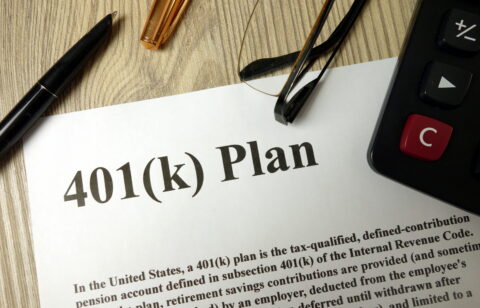
Not much happens to your 401(k) at first. If you get fired, you don’t lose your 401(k). The money you contributed is yours. The employer match depends on vesting. What happens next depends on how much is in the account, what you do with it, and whether you have an outstanding loan.
Your Contributions Are Yours. The Match Depends on Vesting.
Every dollar you put in from your paycheck is 100% yours, plus any investment gains or losses. Getting fired doesn’t change that.
The employer match is different. Most plans use a vesting schedule, which means the company’s contributions become yours over time. Two common types: cliff vesting (you own 0% of the match until a set anniversary, then 100%) and graded vesting (ownership grows in chunks each year, often 20% per year over five).

By law, employer matching contributions can’t take longer than three years to fully vest under a cliff schedule or six years under a graded schedule. Some plans vest faster, but these are the maximum time limits allowed.
Let’s say you contributed $12,000 over the years. Your employer added $4,000 in matching funds. You’re 50% vested when you’re fired. You walk away with the full $12,000 you contributed, plus all the gains on your own contributions. From the match, you keep half: $2,000 of the $4,000, plus half the gains that match earned. The other $2,000 of match, along with the gains on that unvested half, goes back to the plan.
What Your Former Employer Can Do With Your Account
After you’re gone, the plan follows balance-based rules set by the IRS.
- Under $1,000: the plan may cash you out and send you a check.
- $1,000 to $7,000: the plan may roll the balance into a default IRA on your behalf.
- Over $7,000: the account stays where it is until you decide what to do with it.
That last category is the most important. If your vested balance is over $7,000, the plan generally can’t force a distribution, so your money can stay put until you choose what to do with it. Still, that doesn’t mean it should be ignored indefinitely. Be sure to pay attention to any notices from your plan administrator so you don’t miss important updates or deadlines.
Your Four Options
Once you know what’s yours and what the plan is doing, you have four paths.
- Leave it where it is: Allowed if your balance is over the threshold. No new contributions, but the money keeps growing. Investment menu and fees stay the same.
- Roll it into your new employer’s 401(k): Keeps your retirement money in one place. Requires the new plan to accept rollovers.
- Roll it into an IRA: Wider range of investment choices. You’re no longer tied to an employer’s plan menu.
- Cash it out: Possible, but expensive. See the next section for more details.
For rollovers, it’s often best to ask for a direct rollover (also called trustee-to-trustee or custodian-to-custodian). The check goes from the old plan to the new account, never to you.
If the check comes to you instead, you have 60 days to redeposit the full amount. Miss the window, and the IRS treats it as a distribution, i.e., taxable income.
The Cost of Cashing Out
Yes, you can cash out your 401(k) if you get fired, but the amount you receive will usually be much lower than your account balance once taxes and penalties are applied.
An Example
For instance, if you have a $30,000 vested balance and you are under age 59½, you may initially receive $24,000 because, in most cases, the plan withholds 20% upfront for federal taxes. This withholding is not an extra fee. It is credited toward your tax bill when you file your return.
Depending on your tax situation, you may owe more or receive a refund. These are the costs associated with your cash out:
- First, the distribution is taxed as ordinary income. At a 22% federal tax rate, for example, you could owe $6,600 in income taxes.
- Second, you may owe a 10% early withdrawal penalty, or $3,000 on a $30,000 balance.
In our scenario, you would pay a total of $9,600 in taxes and penalties. That means of the $30,000 you initially took out, you would net only $20,400 in the end.
The Rule of 55 (and What It Doesn’t Mean)
There’s one age-based exception worth knowing. According to IRS rules, if you separate from your employer in or after the year you turn 55, the 10% early-distribution penalty doesn’t apply to distributions from that employer’s plan. Public safety workers may qualify at 50.
Three things this rule does not do.
- It doesn’t waive ordinary income tax, only the penalty.
- It doesn’t apply if you’ve already rolled the money into an IRA.
- It doesn’t apply at any other age, no matter the circumstances around your termination.
If You Have an Outstanding 401(k) Loan
If you borrowed from your 401(k) while employed, you were likely repaying it through payroll deductions. Each paycheck reduced your loan balance automatically. Once you leave your job, those deductions stop, and so do the repayments.
At that point, the plan will typically close out the loan by taking the remaining balance from your account. This is known as a “plan loan offset.” Your account balance is reduced by the unpaid amount, usually soon after you leave the employer.
The offset is treated as a distribution. It is subject to ordinary income tax, and if you are under age 59½, it may also be subject to a 10% early withdrawal penalty.
There is a way to avoid the tax hit, but it does not involve repaying the original loan. You can roll over an amount equal to the offset into an IRA or another eligible retirement plan using outside funds. If you do, the offset is treated as a rollover instead of a taxable distribution.
Timing is important. For a qualified plan loan offset—generally when the loan was in good standing, and the offset occurs within one year of leaving—you have until your federal tax filing deadline for that year, including extensions, to complete the rollover.
For example, if the offset occurs in 2026, the deadline would be April 2027, or October 2027 if you file for an extension. If you miss that deadline, the amount is treated as taxable income and may be subject to the penalty.
The Bottom Line
So what happens to your 401(k) if you get fired? It stays yours. Your contributions are yours, your vested match is yours, and the worst outcomes usually come from cashing out without doing the math or ignoring an outstanding loan.