
In October 2026, the Association for Consumer Debt Relief (ACDR), a debt relief industry trade group, released Debt Settlement Program Outcomes, 2016–2025, a study it commissioned from EY (Ernst & Young), one of the Big Four accounting firms. ACDR calls it “the largest analysis ever conducted of the debt settlement industry.” By EY’s estimate, 8.1 million clients enrolled in debt settlement programs from 2016 to 2025, with a combined $195.3 billion in debt. The study covers 28 states and Washington, D.C. Here’s what the numbers show.
The Study at a Glance
- The data: Records on about 2.9 million clients and 19.7 million accounts came from 10 debt settlement companies.
- Industry size, 2016–2025: EY estimates that 8.1 million clients enrolled $195.3 billion in debt across 54.1 million accounts.
- Debt settled, 2016–2025: Settlements covered $102.2 billion in balances, and net savings after fees totaled $29.3 billion.
- Settlements: Among clients who enrolled from 2016 to 2022, 72% settled at least one debt. For those who did, the first settlement came about four months after enrolling, on average.
- Savings: Clients in that group with a settled debt saved $6,370 on average after fees. They got $2.50 in debt reduction for every $1 in fees.
How Big Is the EY Study?
EY started with records from 10 debt settlement companies, “including several of the largest.” Those records covered about 2.9 million clients and 19.7 million accounts enrolled from 2016 to 2025.
To estimate the size of the whole industry, EY also got data from four payment processors, the companies that handle clients’ program deposits and payments. Together, they account for “a large majority of payment processing activity” for debt settlement programs. EY scaled the company records up using the processors’ data and estimated market share.
For comparison, a 2018 study for the American Fair Credit Council (AFCC), another debt settlement industry trade group, covered more than 400,000 clients. The accounting firm Hemming Morse prepared it, using data on 2.9 million accounts. EY’s raw data covers about seven times as many clients and accounts.
How Big Is the Debt Settlement Industry?
Here are EY’s industry-wide estimates for clients who enrolled from 2016 to 2025. The second column shows the smaller group EY used for its results: clients who enrolled from 2016 to 2022.
| Measure | Enrolled 2016–2025 | Enrolled 2016–2022 |
| Clients | 8.1 million | 4.3 million |
| Accounts (debts) enrolled | 54.1 million | 30.0 million |
| Debt enrolled | $195.3 billion | $106.4 billion |
| Debt settled (balances just before settlement) | $102.2 billion | $66.2 billion |
| Net savings after fees | $29.3 billion | $19.8 billion |
Many people who enrolled from 2023 to 2025 are still in their programs, so EY expects the settled debt and savings totals for those years to grow.
Enrollment Roughly Tripled From 2021 to 2024
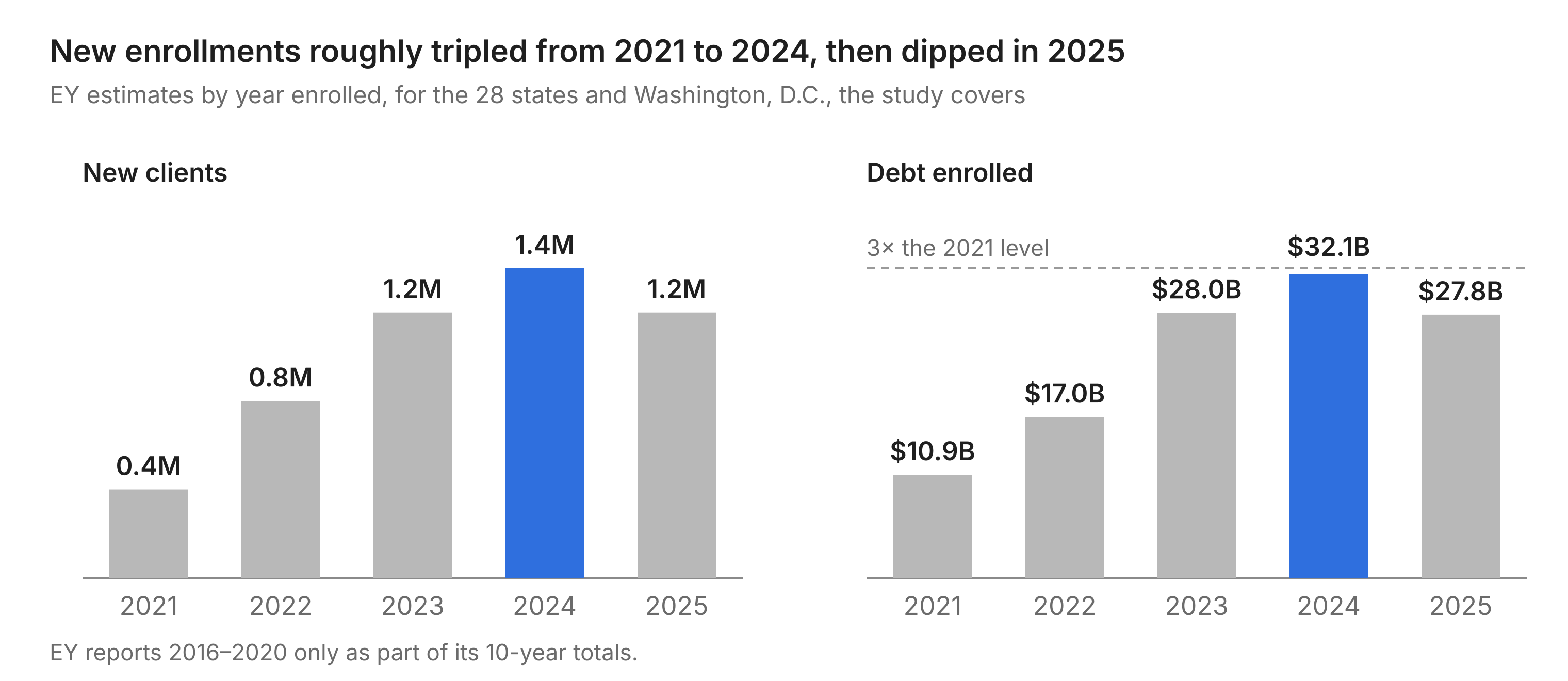
EY breaks out the five most recent enrollment years. New clients rose from about 400,000 in 2021 to about 1.4 million in 2024. Over the same years, enrolled debt roughly tripled, from $10.9 billion to $32.1 billion. Both dipped in 2025, to about 1.2 million clients and $27.8 billion.
Source: EY, Debt Settlement Program Outcomes, 2016–2025, p. 5, Table 1.
Together, these five years account for about 5 million of the 8.1 million clients. Average debt per new client ranged from $22,390 to $25,460 a year. The average new client also enrolled fewer accounts: 5.9 in 2025, down from 7.0 in 2022. Average debt per account rose over the same years, from $3,210 to $3,900.
What the Study Found
EY’s detailed results cover the estimated 4.3 million clients who enrolled from 2016 to 2022. Every client in that group had been enrolled for at least three years by the end of 2025.
Who Uses Debt Settlement
The average client enrolled about $24,920 of debt across 7 accounts, or about $3,540 per account. Most had damaged credit. The median credit score at enrollment was 610, and 80% of clients had scores in the ranges FICO calls “Poor” or “Fair.” That’s 36% Poor (below 580) and 44% Fair (580 to 669).
What Happened to Clients
- Most settled at least one debt. 72% of clients reached at least one settlement, 64% reached at least two, and 59% reached at least three.
- The first settlement came quickly for many. Among clients who reached a settlement, the first one came about four months after enrolling, on average. Nearly all of them (96%) reached it by the eighth month.
- Later settlements came at regular intervals. For clients who reached them, the second came about eight months after enrolling, the third at 11 months, the fourth at 14, and the fifth at 16. The average settled account took about 13 months to reach its settlement.
- Settled debts were cut about in half. On debts that settled, the settlement averaged about 50% less than the balance owed just before settlement. After fees, clients’ net savings averaged 30% of that balance, or $6,370 per client with at least one settled debt. Of those clients, 98% had positive net savings.
- Savings outweighed fees. Clients got $2.50 in debt reduction for every $1 in fees, measured against the balance just before settlement. Measured against the debt they first enrolled, it’s about $2.00. Fees averaged $4,270 per client with a settled debt.
- Most settlements were paid in installments. 90% were paid over time, in 15 payments on average, and 10% in one lump sum. Of the installment settlements, 90% were completed, 6% were still in progress, and 4% were broken. EY says a broken settlement “generally occurs when a client fails to make a scheduled payment.”
How EY Ran the Study
The 10 companies gave EY one record per enrolled account, each tied to a client. EY reviewed the records for consistency and removed outliers. It also dropped accounts with no start date or with an end date before the start date. Some records showed signs of a settlement, such as a settlement date and a fee billed, while the company’s status field said otherwise. EY counted those accounts as settled.
Not every record had every field. When a calculation needed an item a record lacked, such as fees, EY left that account out of it. So the group behind each figure can differ. Here are EY’s defined terms, in plain words:
| Term | What it means in the study |
| Enrolled debt | Debt a client puts into a debt settlement program so a settlement can be negotiated for them |
| Settled debt | The balance on settled accounts just before settlement |
| Settlement amount | What the client agrees to pay and the creditor agrees to accept to fully resolve the debt |
| Debt reduction | The balance just before settlement minus the settlement amount |
| Net savings | Debt reduction minus fees |
| Settled account | A debt that reached a settlement agreement, whether that settlement is in progress, completed, or broken |
| Term-based settlement | A settlement paid through a series of negotiated payments instead of one lump sum |
Frequently Asked Questions
Who conducted the EY debt settlement study?
EY (Ernst & Young), one of the Big Four accounting firms, conducted it. Its report, Debt Settlement Program Outcomes, 2016–2025, is dated September 2026.
Who commissioned the study?
The Association for Consumer Debt Relief (ACDR), a debt relief industry trade group, commissioned it. The underlying data came from 10 debt settlement companies.
How many clients were in the study?
EY’s raw data covered about 2.9 million clients and 19.7 million accounts. EY estimates that, industrywide, 8.1 million clients enrolled from 2016 to 2025 in the 28 states and Washington, D.C., it covers.
Where can I read the full report?
The full report is available as a PDF. ACDR announced it in a press release on Oct. 5, 2026.