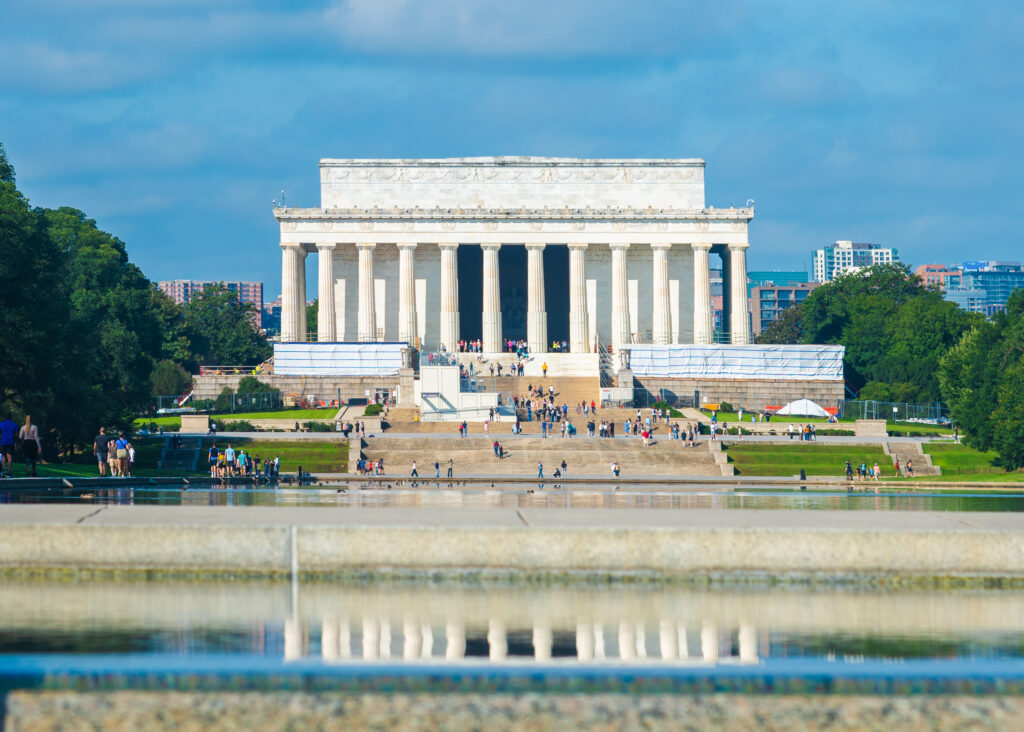
On a recent visit to the Lincoln Memorial Plaza in Washington, D.C., I encountered something both unmistakably modern and profoundly timeless: the National Military Monument. Positioned in one of our nation’s most symbolic public spaces—between monuments to Washington and Lincoln and overlooking the Reflecting Pool—it skips bronze statues and granite inscriptions in favor of a moving digital roll call of the Americans who have served our country.
I went expecting an impressive installation. I left reflecting on names, faces, families, sacrifice, and the remarkable continuity of service that has helped preserve the freedom we have defended while serving in uniform.
The monument is temporary, but the experience stays with you.
A Monument for a Milestone
The National Military Monument opened on July 28, 2026, as part of the nation’s commemoration of America’s 250th anniversary. Its premise is simple: recognize the more than 41 million Americans who selflessly served from the Revolutionary War to the present day. Rather than focusing on a single conflict, branch, generation, or famous leader, it seeks to make visible the enormous human chain of service that links the country’s earliest days to today.
That is an important distinction. Washington, D.C., rightly contains memorials to particular wars, units, leaders, and moments of national grief or achievement. This installation attempts something different. It invites the visitor to recognize that America’s military story belongs to more than its celebrated figures. It also belongs to the farm boy who enlisted in 1861, the immigrant who served in World War I, the nurse who cared for wounded troops in World War II, the sailor on a Cold War deployment, the reservist mobilized after September 11, and the young service member currently standing watch far from home.
The physical installation consists of two large, double-sided digital displays shaped to resemble American flags moving in the wind. Each is 18 feet high and 108 feet long. Across those digital flags, names scroll continuously, with about 6,000 names visible at a time as the display cycles through the larger registry. It is an innovative use of technology, but its effect feels more personal than futuristic. Names have a way of turning statistics back into people.
An Experience Made Personal
What made the visit particularly memorable for me was the ability to look up individual names and have them appear on the monument.
Using the on-site search process, I was able to get a photograph with the names of George Washington and Audie Murphy displayed above mine. It was a meaningful moment: standing there at the Lincoln Memorial Plaza, with a visual connecting three Americans from vastly different eras of our military history.
Washington was, of course, the commander in chief of the Continental Army and the nation’s first president. Audie Murphy, the nation’s most highly decorated World War II Army soldier, came to represent a later generation’s courage under fire. Their service unfolded under completely different circumstances, yet the monument allowed me to place all three of us within the same uninterrupted national story, a reminder of the connection we all share through our service in uniform.
That is the power of the installation. It doesn’t suggest that all service experiences are identical. Service in wartime differs from service in peace; a combat tour differs from stateside duty; the experiences of active-duty personnel, Guardsmen, Reservists, veterans, and military families are each distinct. But the monument reminds us that all who took the oath became part of a larger tradition of duty to the nation.
(Insert photograph with George Washington, Audie Murphy and Gerald Quinn names displayed here)
How to Find a Name
You do not have to visit Washington to participate. The monument’s searchable online registry allows anyone to look for a veteran, current service member, family member, friend, or former colleague. Visit The National Military Monument’s online search and enter the name of the person you are seeking. The search is available from home, making the experience accessible to families who cannot travel to the National Mall.
If you visit in person, scan the QR code or use an interactive kiosk to search for a name. The process provides a code that staff members can use to bring that name onto the digital flags, allowing visitors to photograph the moment.
And if you do not find the person you are looking for, do not assume that his or her service has been forgotten. No single database contains a complete record of every American who has served. The monument’s registry was assembled from numerous historical and public sources, including National Park Service records, World War II Army enlistment files, prisoner-of-war lists, Department of Veterans Affairs records, and information from veteran organizations. Gaps in older records, variations in names, incomplete documentation, and privacy considerations mean that some names may not yet appear.
The good news is that the registry is intended to grow. From the monument website, follow the prompts to submit the veteran’s or service member’s information for review and verification. Once verified, the record may be added in a future update.
Worth Seeing Before It Closes
The monument was originally scheduled to remain on the National Mall only through August 23. The public response, however, was strong enough that its stay was extended through November 12, 2026. Nearly 5 million names were searched in its first three weeks, a remarkable sign that Americans still want opportunities to remember those connected to military service.
It is free and open daily from 10 a.m. to 10 p.m. at the Lincoln Memorial Plaza.
For veterans, this may be an opportunity to see your own name—or that of a parent, grandparent, shipmate, battle buddy, or loved one—placed within the nation’s broader military story. For families and civilians, it is a reminder that freedom has always depended on ordinary Americans doing extraordinary things when called.
The National Military Monument will eventually be dismantled. But the names, the service they represent, and the obligation to remember them should endure.
USAA designed and sponsored the National Military Monument, and it deserves sincere appreciation for undertaking a project of this scale. As a company founded in 1922 with deep roots in the military community, USAA has given the public an accessible tribute that is free to visit and designed to include names from every generation of American service.