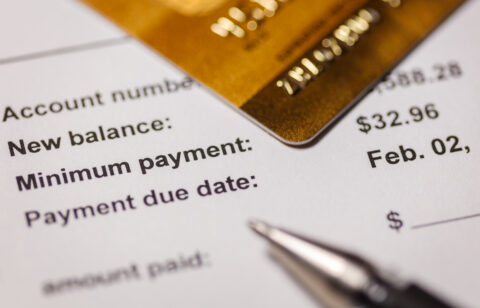


When you pay a credit card bill, you may notice a charge on your statement that is beyond the amount of money you actually spent. That’s a finance charge. It’s the cost of borrowing, expressed as a dollar amount.
This article explains how to calculate a finance charge step by step using the method that many credit card issuers use. We’ll cover the key terms and the math. We’ll also provide an example and explain why your statement might not precisely match a back-of-the-envelope estimate.
What Is a Finance Charge?
A finance charge is the dollar cost of using credit. It includes interest and possibly specific fees tied to borrowing. In everyday use, “finance charge” and “interest” are often treated as the same thing. In reality, the terms are close in meaning, but not identical.
Interest is usually the largest cost when borrowing. But cash advance fees, balance-transfer fees and some late fees can also be part of the finance charge, depending on your lender’s terms.
There is no single “typical” finance charge. The amount depends on your annual percentage rate (APR), your balance, how long your billing cycle runs and any applicable fees.
Key Terms to Know Before You Calculate
These five terms appear on many credit card statements. Getting comfortable with them makes the math much easier to follow.
| Plazo | What It Means |
| APR (Annual Percentage Rate) | Your yearly interest rate, plus any extra fees. |
| Daily Periodic Rate | The APR broken down by day. Divide your APR by 365 to get this number. |
| Average Daily Balance | The average of what you owed each day during the billing cycle. Payments and new purchases both affect it. |
| Billing Cycle | The period between statements, usually 28 to 31 days. |
| Grace Period | The window between your statement closing date and your payment due date. Pay in full during this period, and you typically owe no interest on purchases. |
How to Calculate a Finance Charge
Many credit card issuers use the average daily balance method. The formula is straightforward:
Finance charge = Average daily balance × Daily periodic rate × Days in billing cycle
Here is how to work through it.
Step 1: Convert Your APR to a Daily Periodic Rate
Divide your APR by 365. Most issuers use 365, although some use 360. Check your cardholder agreement if you want to be exact.
Example: An 18% APR ÷ 365 = 0.0493% per day, or 0.000493 as a decimal.
Step 2: Find Your Average Daily Balance
Add up your account balance at the end of each day in the billing cycle, then divide by the number of days in the cycle. If you made a payment halfway through the month, your balance dropped for the remaining days, which lowers your average.
Example: You carry $1,000 for all 30 days of the cycle with no transactions. Your average daily balance is $1,000.
Step 3: Multiply Through
Take your average daily balance, multiply it by the daily periodic rate, then multiply by the number of days in the billing cycle.
Example: $1,000 × 0.000493 × 30 = $14.79
A Full Worked Example
Here is the same calculation laid out clearly, so you can follow each step with your own numbers.
| Input | Value |
| Average daily balance | $1,000 |
| APR | 18% |
| Daily periodic rate (18% ÷ 365) | 0.000493 |
| Days in billing cycle | 30 |
| Finance charge (step 3) | $14.79 |
If you had made a $200 payment on day 15, your average daily balance would have been lower than $1,000, and your finance charge would have been lower too.
The reverse is also true: If you had added $200 in new purchases early in the cycle, the average daily balance would have exceeded $1,000, and the finance charge would have risen.
So, the timing of payments and new charges both affect what you end up owing.
Why Your Statement Might Not Match
The formula above is a good estimate. But the number on your actual statement can differ for a few reasons.
- Multiple APRs: Cards can apply one APR to regular purchases, a higher rate to cash advances and a separate rate to balance transfers. Each balance type is calculated separately, then added together.
- Daily compounding: Some issuers add interest to your balance each day before calculating the next day’s charge. That compounds the cost slightly above what a simple estimate would show.
- 360 vs. 365 days: Some issuers divide the APR by 360 rather than 365. A small difference in the denominator produces a slightly different daily rate.
Your cardholder agreement is the authority on which method applies to your account. If you want to verify a specific charge, the statement itself will usually show your average daily balance, daily periodic rate and the number of days used in the calculation.
What Finance Charges Add Up to Over Time
A single billing cycle charge might look small. But carrying a balance month after month changes the picture.
Take that same $1,000 balance at 18% APR. Paid off in six months, your total finance charges are roughly $54.
However, carry it for two years and make only minimum payments, and the total interest paid climbs well past $200, depending on your minimum payment terms. The balance declines slowly when most of each payment goes toward interest rather than principal.
Principales conclusiones
Knowing how to calculate a finance charge gives you a way to check your statement rather than just accept it.
One common formula is: average daily balance × daily periodic rate × days in the billing cycle.
For many credit cards, that covers the interest portion of your finance charge. If your account has fees tied to specific transactions, those may appear separately.
When the amount on your statement differs from your estimate, your cardholder agreement will specify exactly which method your issuer uses.